
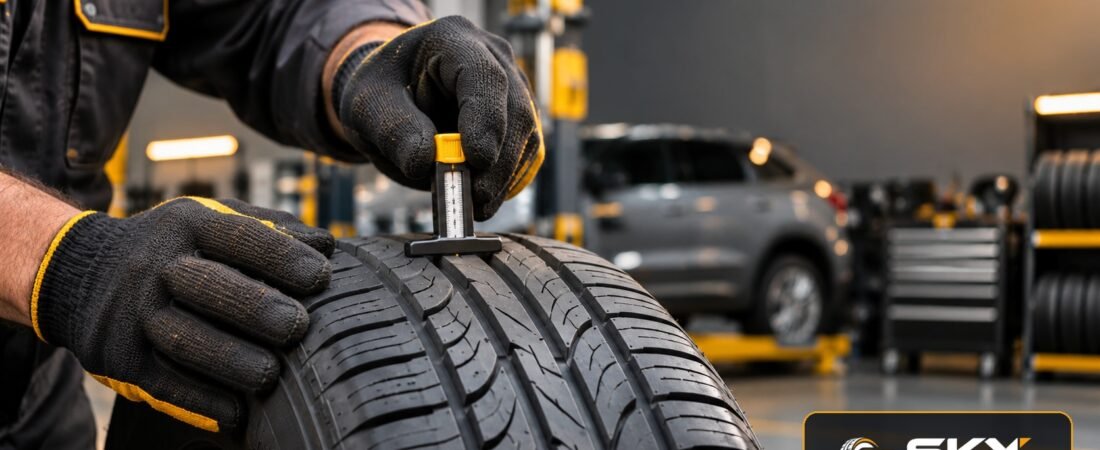
Your car tyres do more than keep the vehicle moving. They are the only parts of the car that maintain direct contact with the road, helping you steer, brake and stay stable. Yet tyre replacement is often delayed until a puncture or a roadside problem forces the decision.
So, when is the right time to change car tyres? The answer is not based on mileage alone. Tread depth, visible damage, pressure loss, driving behaviour and the tyre’s age all matter. Here are seven warning signs every driver should know, along with practical checks you can carry out before your next journey.
AI Overview: When should you change car tyres?
Change a car tyre when its tread has reached the wear indicators or the minimum limit specified by the tyre manufacturer and applicable local rules, or sooner if it has structural damage. Bulges, deep cuts, exposed cords, repeated air loss, unusual vibration and serious uneven wear all need prompt professional inspection. Tyre age also matters: check the manufacturing date and follow the vehicle and tyre maker’s replacement guidance. Inspect tyres monthly and before long trips.
Why is timely tyre replacement important?
Tyre tread helps channel water away from the contact area and supports grip when you accelerate, corner or brake. As the tread wears, the tyre has less ability to deal with standing water, and worn or damaged rubber can affect handling. A tyre may also be unsafe even when it still looks reasonably new: an impact, a sidewall defect or internal damage can be difficult to judge from the outside.
For drivers travelling through Srinagar and other parts of Kashmir, changing road conditions make regular checks especially useful. Wet roads, rough patches, potholes and long journeys can expose weaknesses that may not be obvious during a short drive around town.
7 warning signs that your car tyres may need replacement
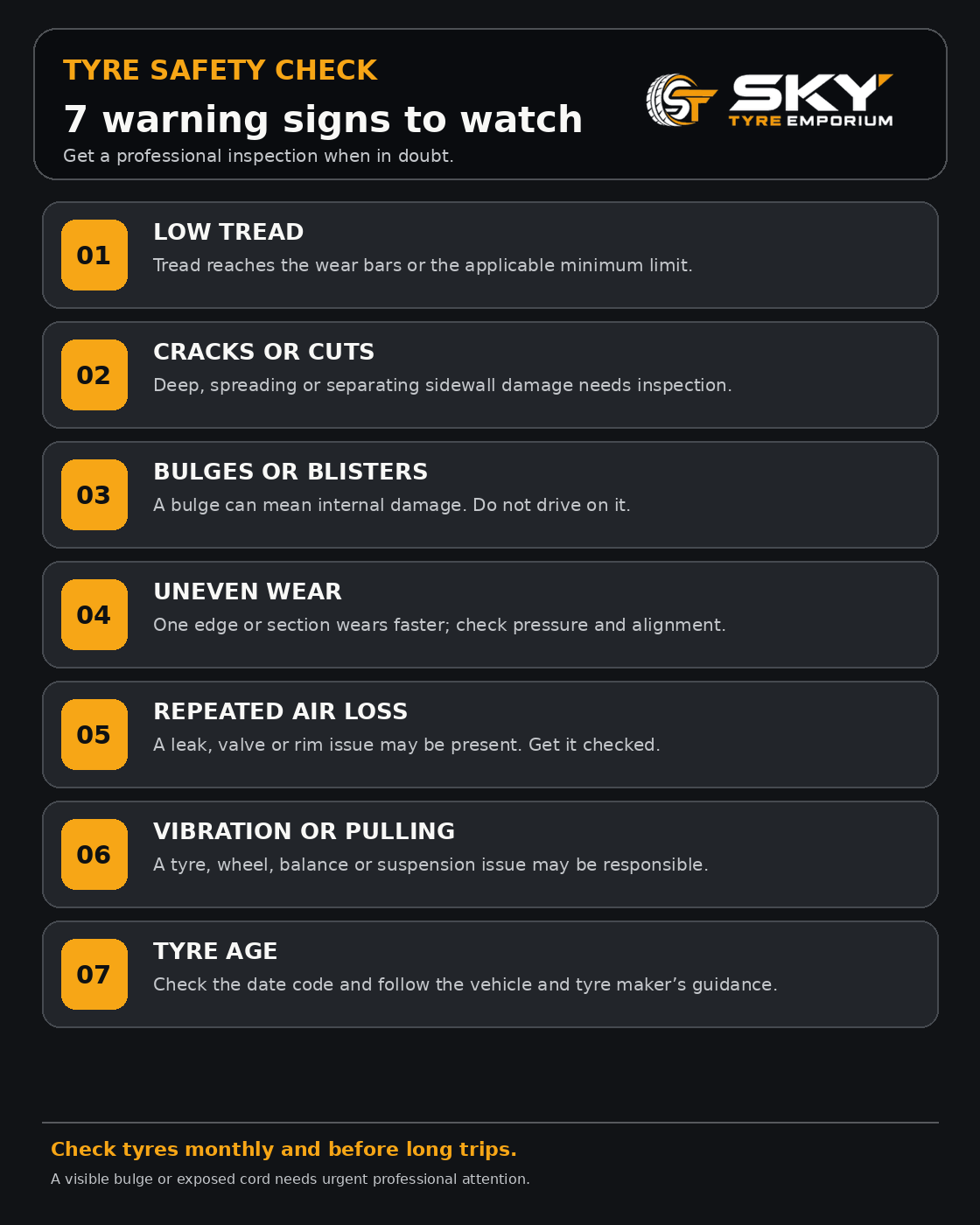
1. The tyre tread is too low
Tread is the patterned rubber on the surface of the tyre. Its grooves help move water away from the contact patch and provide grip. As the tyre wears down, wet-weather performance can deteriorate.
Look for the small raised tread-wear indicators inside the main grooves. When the surrounding tread becomes level with these bars, the tyre has reached its wear limit and should be replaced. A tread-depth gauge gives a more precise reading; check several points across the width of each tyre because wear may not be even. Michelin India explains how to identify and read tyre-wear indicators.
Do not wait for the tyre to look completely smooth. Follow the minimum tread-depth requirement that applies to your vehicle and location, as well as the tyre manufacturer’s advice. If you are unsure about the reading, ask a tyre professional to measure it.
2. You notice cracks or cuts on the sidewall
The sidewall is the flexible outer section between the tread and the wheel rim. It bends as the tyre moves, so damage in this area deserves attention. Look for visible cracking, deep cuts, splits or rubber that appears to be separating.
Small surface marks can have different causes, and not every mark means the tyre must be discarded. However, deep or spreading cracks and cuts should be checked promptly by a qualified tyre technician. Do not try to judge structural safety from a photograph or cover the damage with a temporary patch.
3. There is a bulge or blister on the tyre
A bubble-like swelling on the sidewall or tread can indicate damage to the tyre’s internal structure. It may follow a hard impact with a pothole, kerb or road obstacle. The outer rubber can remain intact while the internal layers are weakened.
A visible bulge is a serious warning sign. Avoid continuing to drive on that tyre; arrange a safe stop and seek professional assistance or roadside help. A bulge is not something that can be fixed by adding air or applying an external patch.
4. The tread is wearing unevenly
Check whether one shoulder, the centre or isolated sections of the tread are wearing faster than the rest. Uneven wear can be linked to incorrect inflation pressure, wheel misalignment, worn suspension parts, poor balancing or a lack of regular tyre rotation.
Uneven wear does not automatically mean every tyre needs replacing. A technician should measure the remaining tread and identify the cause. If the tyre has worn down to its wear indicators or has developed structural damage, replacement may be necessary. Correcting the underlying alignment, pressure or suspension issue helps prevent the same problem from affecting the replacement tyres.
5. The tyre keeps losing air
If you have to refill the same tyre repeatedly, do not treat it as a routine inconvenience. A nail or other object, a leaking valve, a damaged wheel rim or an internal tyre problem may be responsible. Driving while underinflated can generate excess heat and cause further damage.
Check pressure when the tyres are cold and use the pressure recommended by the vehicle manufacturer, usually shown on the driver’s door label or in the owner’s manual. Do not use the maximum pressure printed on the tyre sidewall as your everyday target. Have recurring pressure loss inspected by a tyre professional; some punctures may be repairable, while others require replacement.
6. You feel vibration, pulling or a change in handling
New or persistent vibration through the steering wheel, a vehicle that pulls to one side, unusual road noise or a change in cornering feel can point to a tyre or wheel problem. Possible causes include imbalance, uneven wear, alignment issues, wheel damage or internal tyre damage.
These symptoms do not prove that a tyre needs replacing, but they should not be ignored. Reduce speed, stop somewhere safe if the vehicle feels unstable, and arrange an inspection. A technician can determine whether the issue requires balancing, alignment, repair or a new tyre.
7. The tyres are ageing, even if the tread looks fine
Tyre rubber changes over time due to heat, sunlight, storage conditions, inflation, loading and use. This means a tyre’s condition cannot be judged by tread depth or kilometres driven alone. A vehicle that is used infrequently may still have tyres that have aged.
Find the manufacturing date marking on the tyre sidewall and check the tyre maker’s guidance for your model. On tyres carrying a four-digit date code in the DOT identification, the final four digits indicate the week and year of manufacture; for example, 1824 means the 18th week of 2024. Not all tyre markings use the same format, so ask a tyre professional if you cannot identify the date. There is no single age that applies to every tyre in every condition: follow the vehicle and tyre manufacturer’s inspection and replacement recommendations.
How often should you inspect your car tyres?
A quick monthly inspection can help you spot problems before they become urgent. Check all four tyres, including the inner and outer shoulders where you can see them safely. Also inspect before a long journey and after a significant impact with a pothole or kerb.
- Check cold tyre pressure against the vehicle manufacturer’s recommended figures.
- Look for cuts, cracks, bulges, embedded objects and unusual wear.
- Check tread depth at several points across each tyre.
- Notice changes in steering, braking feel, noise or vibration.
- Have recurring pressure loss or uneven wear assessed by a professional.
Can you replace only two tyres instead of all four?
It depends on the vehicle, drivetrain, tyre condition and manufacturer’s instructions. If only two tyres need replacement, the new tyres should be compatible with the vehicle and the existing pair. On many vehicles, tyre makers recommend fitting the pair with better tread to the rear axle to help maintain stability, but some all-wheel-drive systems have strict requirements for matching tyre circumference and tread depth.
Do not decide based only on price. Ask the technician to check the owner’s manual, tyre size, load and speed ratings, and the condition of the remaining tyres before fitting a pair.
Choosing the right replacement tyres
When it is time to replace a tyre, match the size and specifications approved for your vehicle. Check the load index and speed rating, consider the type of roads you regularly use, and choose a tyre from a reputable manufacturer. A correct fitment matters just as much as the brand name.
If you are still comparing options, read our guide on how to choose the right tyres. For practical habits that can help extend tyre life, see 7 simple tips to make your car tyres last longer.
When should you visit a tyre professional?
Get professional help if you notice a bulge, deep cut, exposed cord, repeated air loss, sudden vibration or a rapid change in handling. If a tyre appears unsafe, avoid driving on it and arrange roadside assistance. A trained technician can inspect the tyre internally where appropriate, measure tread depth, check the wheel and advise whether repair or replacement is safe.
Drivers looking for tyre support in Srinagar can contact Sky Tyre Emporium to ask about suitable tyre options and professional assistance. Always confirm the correct fitment for your vehicle before purchasing.
Frequently asked questions
1. How do I know when my car tyres need changing?
Look for tread worn down to the wear indicators, sidewall cracks or cuts, bulges, exposed cords, repeated pressure loss and unusual vibration. Have any suspected structural damage checked promptly by a tyre professional.
2. How many years do car tyres last?
There is no reliable age that applies to every tyre. Service life depends on the tyre, vehicle, climate, storage, inflation, loading and use. Check the manufacturing date and follow the vehicle and tyre manufacturer’s inspection and replacement guidance.
3. What is the minimum tread depth for car tyres?
Minimum requirements depend on the rules that apply to your vehicle and location. Michelin India identifies 1.6 mm as the minimum tread-depth reference for passenger-car tyres. Check the rules that apply to your vehicle and location, and replace the tyre when it reaches its wear indicators. Wet-weather grip can be reduced as tread wears, so do not wait for a tyre to become visibly smooth.
4. Can I drive with a bulge on my tyre?
No. A bulge can indicate internal structural damage and a risk of sudden failure. Avoid driving on it and arrange safe assistance or a professional inspection.
5. Why are my tyres wearing out unevenly?
Common causes include incorrect tyre pressure, wheel misalignment, worn suspension components, imbalance and irregular rotation. Ask a technician to identify the cause before fitting replacement tyres.
6. Should I replace all four tyres at the same time?
Not always. The correct approach depends on the vehicle and drivetrain. Some all-wheel-drive vehicles require closely matched tyres. If replacing only two, ask a qualified technician which axle they should be fitted to and confirm compatibility with the remaining pair.
7. How often should I check my car tyres?
Check tyre pressure and condition at least once a month and before long trips. Inspect them sooner after a hard impact, unusual vibration or a warning from the tyre-pressure monitoring system.
Final thoughts
The best time to change car tyres is before wear or damage compromises safe driving—not after a tyre fails on the road. Make a habit of checking tread depth, sidewalls, pressure and overall condition. When something looks or feels unusual, get it inspected rather than guessing.
For drivers in Srinagar and across Kashmir, regular tyre checks are a simple part of preparing for changing road conditions and longer journeys. If you need help selecting a suitable replacement, contact Sky Tyre Emporium and confirm the right tyre specification for your vehicle.
Helpful references
- NHTSA: Tire safety, tread wear, ageing and maintenance
- Michelin India: How to interpret tyre-wear indicators
- Michelin India: When to change tyres
- Michelin India: Tyre maintenance and wear FAQs
- Michelin India: Tyre age, inspection and service life
- Goodyear India: Understanding tyre markings and specifications