
Choosing new car tyres is not just about finding a familiar brand or the lowest price. The right tyres help your vehicle brake, steer and remain stable in the conditions you actually drive in. In Srinagar, that may mean city traffic, uneven road surfaces, highway journeys, rain and, on some routes and at certain times of year, colder or snowy conditions.
If you are searching for the best car tyres in Srinagar, this guide explains what to check before buying: tyre size, load and speed ratings, tread design, road conditions, manufacturing date, warranty and professional fitting. The goal is to help you make a safe, confident and sensible choice for your car and budget.
AI Overview: How do you choose the best car tyres in Srinagar?
Start with the tyre size and specifications approved by your vehicle manufacturer. Compare load index, speed rating, tyre type, wet-road grip, tread design, comfort, manufacturing date, warranty and price. Consider the roads and weather you regularly encounter, but do not change tyre size or fitment without confirming compatibility with the vehicle manufacturer or a qualified tyre professional. Buy genuine tyres from a reliable dealer, ask for an invoice and have them fitted, inflated and balanced correctly.
Why choosing the right tyres matters on Srinagar roads
Your tyres are the only part of your car that makes direct contact with the road. Their condition and suitability influence braking, steering response, cornering stability and ride comfort. A tyre that looks sporty or costs less is not automatically the right option for your car.
Driving around Srinagar can involve stop-and-go traffic, smoother city roads, longer highway stretches, rough patches and wet surfaces during rainy periods. If your journeys take you towards higher-altitude areas, you may also encounter colder conditions or snow. There is no single tyre that is best for every driver. The sensible choice matches your vehicle specifications and usual routes.
1. Start with the correct tyre size for your car
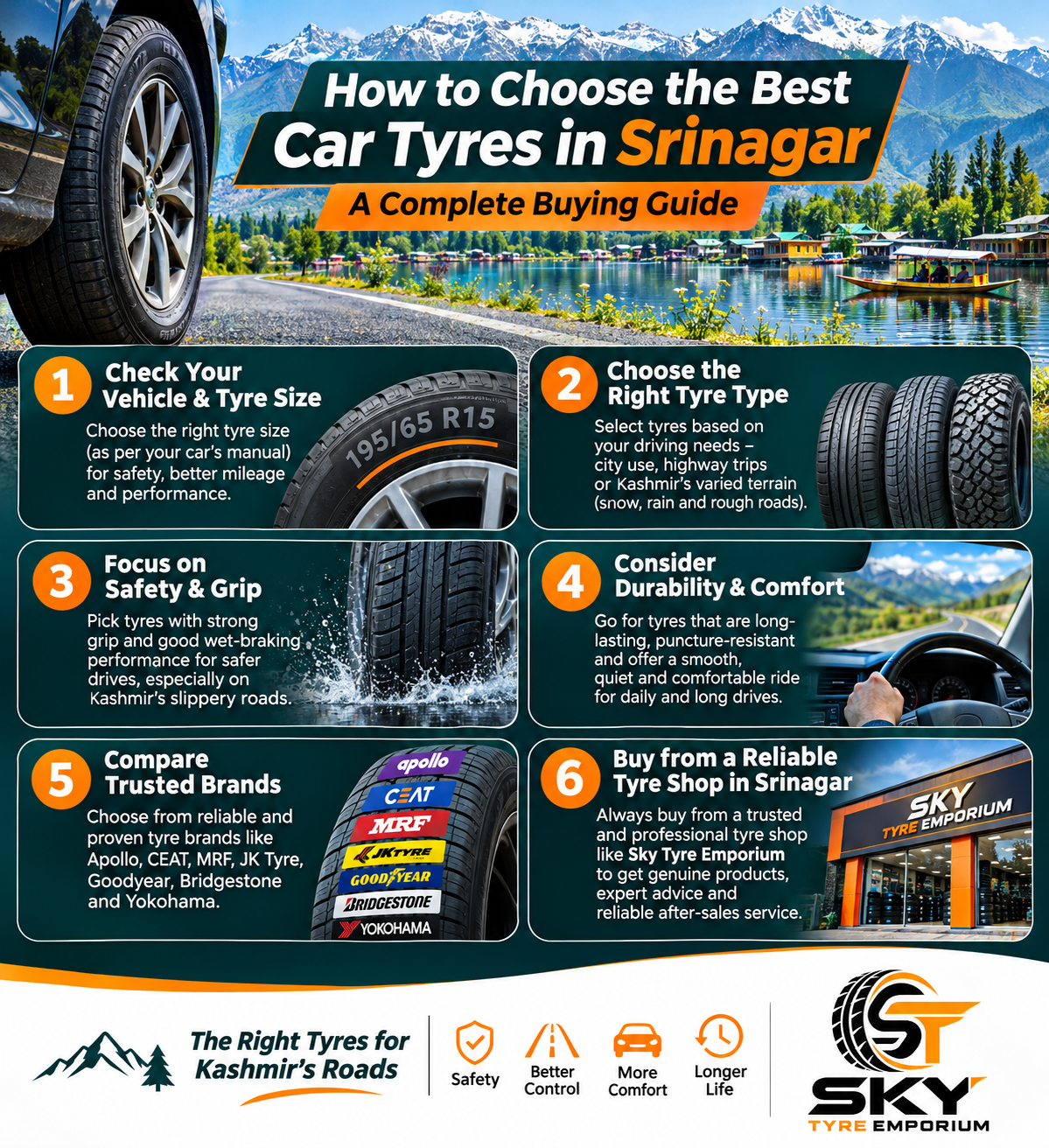
Before comparing brands or prices, confirm the exact tyre size recommended for your vehicle. You can usually find it in the owner’s manual, on the tyre information placard around the driver’s door opening, or in the manufacturer’s documentation. The size printed on your current tyre is a useful reference, but check it against the vehicle specification—especially if wheels or tyres have been changed previously.
A marking such as 205/55 R16 is read as follows:
- 205: nominal tyre section width in millimetres.
- 55: aspect ratio—the sidewall height expressed as a percentage of width.
- R: radial construction.
- 16: wheel rim diameter in inches.
This is an example, not a recommendation for every car. Two tyres with the same dimensions can still have different load and speed ratings. Avoid choosing a different size just because it looks wider. An unapproved change can affect clearance, handling and speedometer readings. Follow the vehicle maker’s approved fitment options.
2. Check the load index and speed rating
The number and letter printed after the size—such as 91V—refer to the load index and speed symbol. The load index identifies the tyre’s rated load capacity under specified conditions. The speed symbol identifies its rated speed category when carrying the specified load.
Always meet the minimum load and speed specifications stated by your vehicle manufacturer. Do not fit a tyre with a lower rating just because it is cheaper or available immediately. If you are considering a different specification, confirm that it is approved for your vehicle with a qualified tyre professional.
3. Choose a tyre suited to your regular roads and weather
Think about where you drive most. A person who mainly uses a car for city commutes may value predictable wet and dry grip, comfort and low road noise. Someone who regularly travels longer distances may also consider stability and durability, always within legal limits and vehicle specifications.
For Srinagar motorists, wet-road performance deserves attention. Look for reliable product information and independent test results where available, rather than relying only on a sales claim or tread appearance. If your regular travel includes areas with sustained snow or ice, ask a tyre professional whether a dedicated winter tyre or suitable all-season option is appropriate. Ordinary road tyres should not be assumed to provide winter-tyre performance.
Weather suitability depends on the actual tyre design and markings, not just the brand name. Check the manufacturer’s product description for the exact model and size.
4. Understand tread pattern, grip and comfort
Tread grooves and blocks help manage water, provide road contact and influence noise and handling. Different designs are developed for different uses. A more aggressive-looking pattern is not automatically safer or better for everyday city driving. The complete tyre design—including compound, construction and tread—is what matters.
- Does the manufacturer provide information about wet braking and handling?
- Is the tyre designed for the city, highway or mixed driving you do?
- Does the model prioritise comfort and lower road noise, or a sportier response?
- Are credible independent tests available for the model or a comparable size?
- Does it have directional or inside/outside markings that the fitter must follow?
5. Compare trusted tyre brands and specific models
Drivers may come across established names such as Apollo, CEAT, MRF, JK Tyre, Goodyear, Bridgestone and Yokohama while shopping for car tyres in Srinagar. These are useful brands to compare, but the brand name alone cannot tell you which tyre is best for your car.
Compare the exact model available in your required size. Look at its intended use, load and speed ratings, wet and dry performance information, comfort, warranty conditions and price. A premium model may offer features you value, while another may better suit your driving needs and budget. Ask the dealer to explain the differences between the actual models being quoted.
Availability can vary by size and stock. Confirm the exact model, manufacturing details and warranty with the seller before making payment.
6. Check the manufacturing date and tyre condition
Before accepting a new tyre, inspect it carefully. Check the sidewall and tread for cuts, cracks, bulges, exposed cords, deformation or other visible damage. Make sure the size and ratings match your vehicle and that the tyre is the exact model you agreed to buy.
Many tyres carry a four-digit date code at the end of the relevant manufacturing identification marking. In this format, the first two digits indicate the week and the last two the year. For example, 3625 represents the 36th week of 2025. Ask the dealer to show you the code and explain the manufacturer’s guidance on storage, service life and warranty. Do not judge safety from the date code alone: age, storage, condition, use and manufacturer guidance all matter.
Check that the tyre is genuine, supplied through a reliable channel and accompanied by a proper bill. Keep the invoice and warranty documents.
7. Understand warranty, invoice and after-sales support
Ask what the warranty covers and excludes. Conditions differ between manufacturers and products. Clarify the warranty period, documents required for a claim and whether registration or inspection is necessary. Get the terms in writing rather than relying on a verbal promise.
A clear invoice should identify the tyre brand and model, size, quantity and amount paid. Keep any warranty card or digital record. If a seller offers an unusually low price, check product details, authenticity, manufacturing information and paperwork before proceeding.
8. Do not overlook professional fitting, balancing and alignment
Even a suitable tyre needs to be fitted correctly. Ask the workshop to check wheel and rim compatibility, inspect the valve, mount the tyre in the correct direction where applicable, and inflate it to the vehicle manufacturer’s recommended pressure. Wheel balancing helps reduce vibration caused by uneven wheel-and-tyre mass distribution.
Wheel alignment is a separate adjustment of wheel angles to the vehicle manufacturer’s specifications. It may be worth checking if the car pulls to one side, the steering wheel is off-centre or tyres show uneven wear. Alignment is not automatically required every time tyres are replaced; have it inspected when symptoms, wear patterns or vehicle service guidance indicate a need.
After fitting, check that all tyres are inflated correctly and wheel fasteners are tightened to the vehicle maker’s specified torque. Follow the vehicle and tyre manufacturers’ advice for any new-tyre running-in period.
9. How much should you spend on car tyres in Srinagar?
There is no single correct price for a car tyre. Cost depends on size, brand, model, construction, ratings, features and current availability. Larger or less common sizes can cost more, and two models from the same brand may have different prices.
When comparing quotations, make sure you compare like for like: the same size, model, load and speed ratings, and warranty conditions. Ask whether the amount includes fitting, balancing, valves, taxes or other charges. A low headline price may not represent the final amount you pay.
10. Quick checklist before buying new tyres
- Confirm the vehicle manufacturer’s approved tyre size.
- Match the required load index and speed rating.
- Choose a model suited to your regular roads and weather.
- Compare specific models, not just brand names.
- Inspect the tyre, sidewall, tread and manufacturing date.
- Confirm authenticity, warranty terms and invoice details.
- Use a professional fitter and request correct inflation and balancing.
- Check alignment if symptoms or uneven wear suggest a problem.
Where can you buy car tyres in Srinagar?
If you are comparing options for a car tyre shop in Srinagar, Sky Tyre Emporium in Tengpora is a local tyre retailer where motorists can enquire about available options from Apollo, CEAT, MRF, JK Tyre, Goodyear, Bridgestone and Yokohama. Availability depends on the required size and current stock, so confirm the exact model before visiting.
Whether you are replacing one worn tyre or planning a complete set, bring your vehicle details or a clear photograph of the existing tyre sidewall. This makes it easier to check the correct size and ratings before discussing suitable choices. Ask questions, compare the options and choose a tyre that meets your vehicle’s requirements.
Sky Tyre Emporium
Tengpora, Srinagar, Jammu & Kashmir
Frequently asked questions about car tyres in Srinagar
Which are the best car tyres in Srinagar?
The best tyre depends on your car’s approved size and ratings, driving conditions and budget. Compare specific models from Apollo, CEAT, MRF, JK Tyre, Goodyear, Bridgestone and Yokohama, and choose one that meets the vehicle manufacturer’s specifications.
How do I find the correct tyre size for my car?
Check the owner’s manual, the tyre information placard on the vehicle or the manufacturer’s official documentation. The sidewall of your current tyre also displays its size, but confirm it is the approved fitment for your vehicle.
Which tyre brand is better: Apollo, MRF, CEAT or JK Tyre?
There is no universal winner. Compare exact models in your required size, their ratings, performance information, warranty, price and suitability for your driving needs. A brand comparison is most useful when it compares equivalent products.
Are wider tyres better for cars?
Not necessarily. Wider tyres can change steering feel, rolling resistance, clearance and other vehicle characteristics. Use the size approved by the vehicle manufacturer, or get professional confirmation of an approved alternative before changing size.
How can I check the manufacturing date of a tyre?
Look for the manufacturing date code on the tyre sidewall. In a four-digit week-and-year code such as 3625, 36 indicates the week and 25 indicates 2025. Ask the dealer to help locate and interpret the marking.
Should I replace all four tyres at once?
Replacing all four together can help maintain consistent tyre characteristics, but it may not always be necessary. If replacing only two, follow your vehicle and tyre manufacturers’ guidance on matching and axle placement. Have a tyre professional assess tread condition and compatibility across all four wheels.
Do new tyres need wheel balancing?
Wheel balancing should be performed when tyres are fitted to wheels to help prevent vibration caused by uneven mass distribution. Alignment is separate and is needed when symptoms, wear or service guidance indicate it.
Are all-season tyres suitable for Srinagar?
Suitability depends on the exact tyre model, its markings, your vehicle and the conditions on your routes. If you regularly drive in snow or ice, ask a qualified tyre professional whether a dedicated winter tyre is needed. Do not assume every all-season tyre is designed for severe winter conditions.
Where can I buy car tyres in Tengpora, Srinagar?
You can enquire at Sky Tyre Emporium in Tengpora, Srinagar, about available tyre brands and sizes. Share your vehicle model and current tyre size to help confirm stock and suitable options before visiting.
Final thoughts: choose the right tyre, not just the cheapest one
The right car tyre is the one that fits your vehicle correctly and performs reliably in the conditions you actually face. Take a few minutes to check the size, ratings, tread design, manufacturing information, warranty and fitting service. Those small checks can make the buying process clearer and help you avoid an unsuitable purchase.
If you are looking for car tyres in Srinagar, speak with a trusted tyre retailer, compare the exact models available and decide based on compatibility, safety and value—not price alone.
Further reading
- Tyres: How to Choose the Right Tyres – Sky Tyre Emporium
- How to Make Your Car Tyres Last Longer: 7 Simple Tips
- Best Time to Change Car Tyres: 7 Warning Signs Every Driver Should Know